Governing Private Investments
Most family offices have more private investments than any other asset type. They're also the most challenging to govern. Not because anyone decided to skip the governance — but because the document flow is relentless and the lifecycle is long.
30-300
Deals reviewed
per year
2-5%
Result in an
investment
100%
Generate records
requiring governance
A single private investment generates a surprising amount of operational activity. The subscription agreement alone contains the commitment amount, ownership structure, fee terms, investment period, fund term, preferred return, carried interest, hurdle rate, and GP commitment — details that inform every subsequent decision about that position. Then come the capital call notices, distribution notices, quarterly financial statements, capital account reconciliations, K-1s, and periodic investment updates. Over a ten-year fund life, a single position can generate hundreds of documents.
But the governance story doesn't start at the subscription agreement. It starts at deal flow. The 95% of opportunities your team reviews and passes on don't disappear from a compliance perspective — they're part of the investment decision record. When a principal or Investment Committee asks, "What did we look at this year? Why did we pass on that fund?" — the answer should be documented, not reconstructed from memory.
What Best-in-Class Looks Like
The best offices treat the entire private investment pipeline as a governed process — from initial review through a structured due diligence workflow that ends in either an investment decision or a documented pass. When the decision is to invest, the governance continues through document execution, funding coordination, and the setup of ongoing compliance. When the decision is to pass, the opportunity is marked inactive with its due diligence record intact.
Critically, the best offices govern private investments as part of the family's broader governance architecture — because the investment is owned by a trust or entity that's also governed, and the documents, compliance obligations, and workflows that flow from the investment connect directly to that ownership structure. When those connections are visible, the governance compounds. When they're not, every workflow is assembled from scratch.
And the lifecycle doesn't end when a fund sends its final distribution. K-1 obligations can extend a year or two beyond dissolution. Offices that close out a position prematurely miss residual tax documents — and by the time they realize it, the tax deadline has created the urgency their system should have prevented.
If your principal or Investment Committee asked tomorrow for a complete picture — every deal reviewed this year, every pass with the rationale, every active position's commitment status, every K-1 received and every one still outstanding — how long would it take to assemble that? And how much of the answer depends on one person's memory?
The Workflows That Hold It Together
Best-in-class private investment governance runs on a small number of structured workflows that repeat predictably across the life of every position. These exist as pre-built templates. Your Professional Services team can customize them to match your office's processes.
Setup
Private Investment Setup
Hierarchy placement, subscription terms captured, governing documents linked, contacts identified, ongoing compliance established.
Setup
Due Diligence
Guides the team from initial assessment through the invest-or-pass decision. Documents the rationale either way.
Recurring
Financial Reporting
Periodic updates, audited statements, and manager commentary captured consistently.
Event-Driven
Capital Call Process
Step-by-step from notice through funding, documentation, and compliance.
Event-Driven
Distribution Process
Documents filed, amounts recorded, compliance trail intact.
Closeout
Redemption & Wind-Down
Governed closeout — including keeping compliance open for residual K-1s that arrive after dissolution.
Annual
Private Investment Review
A comprehensive compliance assessment within each private investment: documents present and current, workflows complete, approvals documented, ownership verified against governing documents, change events captured. AARK™ performs this review and surfaces what needs attention.
The structure is standard. The details are yours.
A Note on Tax Strategy
Under the Lender Supreme Court decision, family offices can be classified and taxed as a business — if they operate like one. Systematic governance processes, documented workflows, and structured compliance activities are exactly the kind of evidence that supports that classification. Every workflow described above isn't just operational best practice — it's a documented record of a family office functioning as a business.
AARK™ in Action
Evaluate
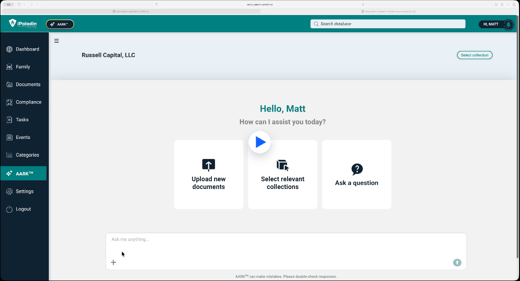
An operator drags in an investor deck. AARK™ creates a new Investment Collection, extracts the key details, generates a document summary, adds a Due Diligence task, and notifies the CIO. The team works the task, uploading diligence documents as they go — everything captured in one place.
| Pass → Inactive | Invest → Active Management |

Invest
The operator uploads the subscription agreement. AARK™ populates the investment details — commitment, interest, fund terms, fee structure, GP identity, preferred return, hurdle rate, tax filing type — flags that purpose and source need human input, and establishes the ongoing compliance workflows: Capital Account Reconciliation, K-1 Reconciliation, and Financial Reporting. Governed from day one.
Operate — Every Day, Every Document
A capital account statement arrives — AARK™ recognizes it, links it to the reconciliation workflow, and proposes marking the step complete. A K-1 arrives — linked to K-1 Reconciliation, step ready for confirmation. A capital call notice comes in — AARK creates the Capital Call Process task and walks the team through funding and documentation. AARK already knows which documents relate to which workflows. The operator confirms, not processes.
Human confirmation at every stage. Due diligence setup, invest-or-pass, hierarchy placement, detail population, compliance configuration, every document linked to a workflow. AARK™ proposes. The team decides.
From Our Professional Services Team
Don't overlook the change events that originate outside your office. Member consents, resolutions to extend the investment horizon, amendments to admit new members — these documents arrive quietly and don't always trigger an obvious workflow. But they change the terms of the investment, and your records should reflect that. The annual Collection Review is where these gaps surface. If you'd like help establishing your review cadence or customizing any of the workflows described above, your Professional Services team is here.
— iPaladin Professional Services